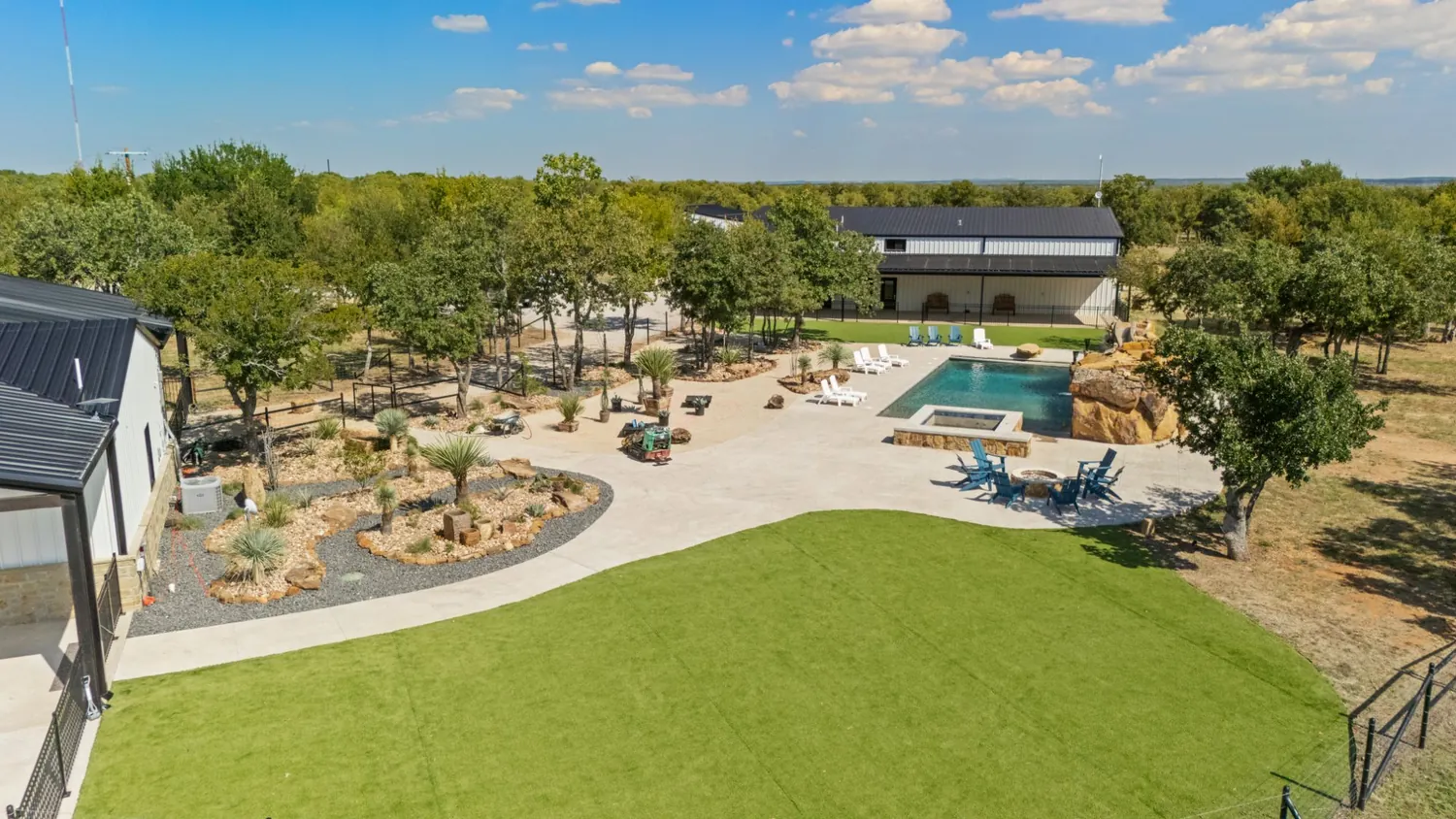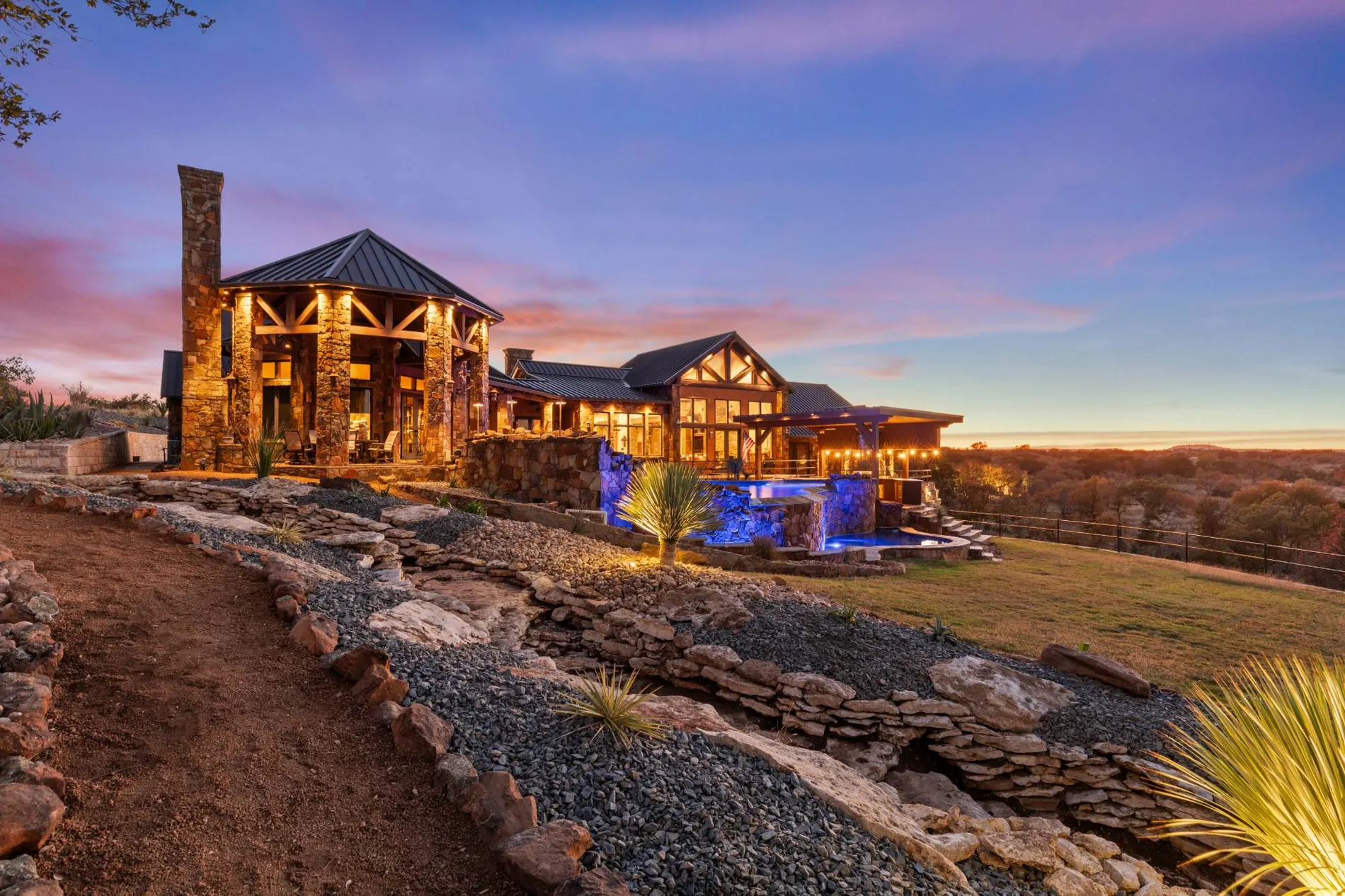
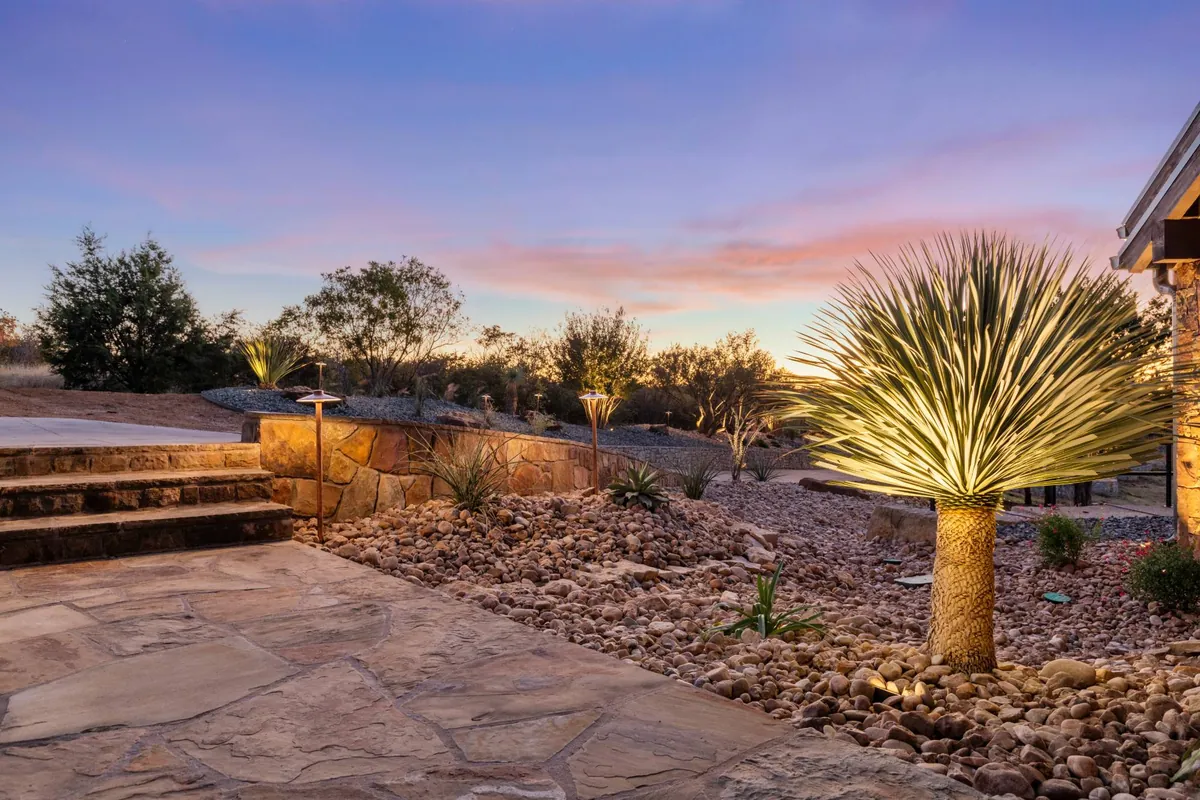
Native stone terraces, walls, steps and entry columns built to the grade of the land rather than against it.
Stone that belongs here
Native building stone, moss rock and flagstone out of this ground. Material trucked in from somewhere else never looks settled next to the ground it is sitting on.
What makes a wall last
Three things, all invisible when it is finished: a footing below the caliche and below frost, drainage behind the wall so hydrostatic pressure has somewhere to go, and proper batter or reinforcement for the height. Walls fail for those reasons, not because of the stone.
What we build
Stone terraces and flagstone floors, terrace and seat walls, ranch entry columns and gate surrounds, steps and paths, fire pits, outdoor kitchen surrounds and cattle-guard aprons. Where a slope would rather be planted than built, that is xeriscape work and we will say so.
Caliche, and why a footing here is not a standard footing
Much of this ground is a thin skin of soil over caliche, and caliche behaves like neither soil nor rock. It is hard enough to stop a hand auger and soft enough to move when it gets wet, which is the worst combination for anything you are trying to keep level. A footing has to get through it and bear on something that does not change with moisture.
The clay is the other half of the problem. Shrink-swell clay lifts and drops through the year, and it will lift a wall that is merely sitting on it. That is why a wall we build starts with excavation you never see and why a wall built without it opens a stair-step crack in its second or third summer.
Drainage is most of what a stone wall is
A wall that holds back soil is really a water problem, because the load that actually breaks walls is water. Saturated backfill exerts hydrostatic pressure the wall was never designed for, and the taller the wall the faster that arithmetic turns against you.
Behind the wall
Clean angular gravel against the back face, not the clay that came out of the hole. Gravel gives water somewhere to go instead of pressing.
Through the wall
A perforated drain at the base, wrapped in filter fabric so it does not silt up, daylighted to somewhere the water is allowed to arrive — which is a drainage decision as much as a stone one, and the reason stone work and drainage are one conversation here.
Over the wall
Grade behind the wall shaped to move surface water along it rather than into it. Most of the water that saturates a backfill never came through the soil; it ran off the slope above and went straight down the back of the stone.
Flagstone: dry-laid or mortared
Dry-laid on a compacted base with a sand or decomposed-granite setting bed moves with the ground, which on clay is a feature. It can be lifted and reset, it drains through, and it is repairable by anybody. Set rigid on a slab it sweeps cleanly and holds furniture without rocking — and when the slab moves, the joints crack, because something has to. We build the dry-laid version.
Which one is right depends on what is under it and how the space is used. A dining terrace that carries a table and chairs wants rigidity. A path across a slope wants to move.
Steps, and the dimension people get wrong
Outdoor steps are not indoor steps. A comfortable exterior rise is lower and the tread deeper than anything you would build inside, and the reason is that people walk outside while looking at something other than their feet. Consistency matters more than the numbers: a single riser that differs from the rest is the one people trip on, every time.
Bulk stone
We sell material out of the Graford yard too — building stone, flagstone, boulders and gravel, pickup or delivered.